Mounting a TV in a Florida Home: Studs, Block Walls and Cords
4 min readMission Critical Home Services
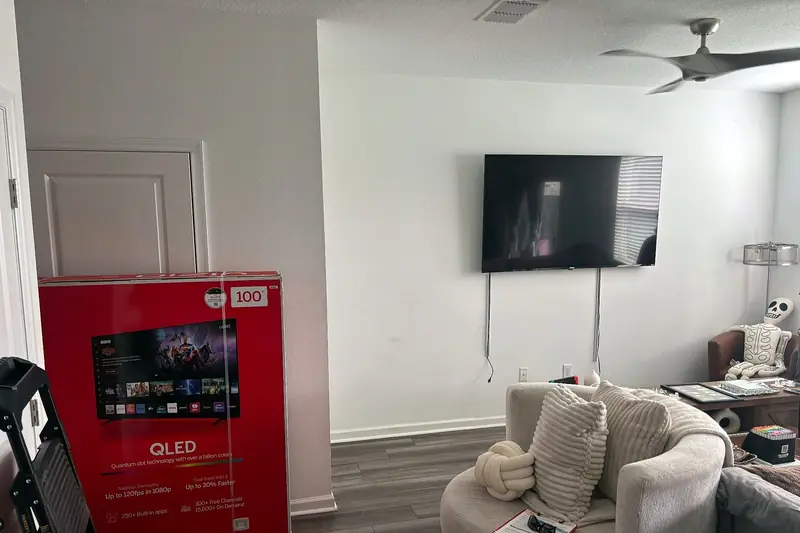
A wall-mounted TV frees up floor space and looks clean. Mounted badly, it sags, tilts or pulls out of the wall. The difference is almost all in what the mount is fastened to, and in Florida that question has a twist: a lot of our outside walls are concrete block.
We mount TVs in Spring Hill and the towns around it all the time. Here's what we check before the drill comes out.
Start with the TV, not the wall
Two numbers decide which mount you can use:
- The TV's weight, from the manual or the manufacturer's spec sheet. Use the weight without the stand.
- The VESA pattern, the spacing of the four threaded holes on the back of the TV, given in millimeters (for example 300 x 300 or 400 x 200).
The mount's box lists the VESA patterns it fits and its weight rating. Pick one that covers your pattern and is rated comfortably above your TV's weight.
Fixed, tilting or full-motion
- Fixed mounts hold the TV close to the wall. Clean look, no adjustment.
- Tilting mounts angle the screen down a few degrees, which helps when the TV sits above eye level or catches glare.
- Full-motion mounts swing out and turn. They're great for corners and open floor plans, but the arm puts far more leverage on the wall, so what you fasten it to matters even more.
What's behind the drywall
This is where most bad installs go wrong.
Interior walls in most homes are framed with wood studs, usually 16 inches apart and sometimes 24. A TV mount should be bolted into the studs, and a stud finder plus a small test hole confirms you've hit the middle of one.
Metal studs turn up in some homes and condos. They need fasteners made for metal studs, and not every mount allows them, so check the instructions.
Outside walls in many Florida homes are concrete block. On the inside, the drywall is often fastened to thin furring strips over the block. Those strips are there to hold drywall, not a TV. On a block wall, the mount has to go through to the block itself, with masonry anchors rated for the load.
Getting the height right
The most common mistake is mounting too high. As a starting point, aim for the center of the screen near seated eye level, which for most couches is somewhere around 40 to 45 inches from the floor. In a bedroom where you watch from bed, a little higher on a tilting mount works better.
Before anything goes on the wall, sit where you normally watch and have someone hold a piece of cardboard the size of the screen in place.
Watch for glare
Florida rooms get a lot of light: big sliders, lanai doors and west-facing windows. Look at the wall you have in mind in the afternoon. A screen that faces a bright window will fight glare all day, and a tilting mount or a different wall usually solves it.
Check for pipes and wires first
Before drilling, scan the wall with a stud finder that also detects live wiring. Electrical cable usually runs straight up or down from outlets and switches, so don't drill directly above or below them. On a wall that backs onto a kitchen or bathroom, assume there may be plumbing behind it.
Hiding the cords the right way
Hidden cords make the whole job look finished, but there's a right way and a wrong way:
- Don't run the TV's regular power cord inside the wall. The electrical code doesn't allow ordinary power cords inside walls; they aren't built for it, and it's a fire risk.
- A paintable cord cover on the wall surface is the simplest answer. Painted to match, it nearly disappears.
- An in-wall power kit made for TVs puts a recessed outlet behind the screen and carries power properly inside the wall.
- HDMI and other low-voltage cables can go inside the wall if they're rated for in-wall use. Look for CL2 or CL3 printed on the jacket.
- A media console under the TV hides whatever is left.
From a recent job
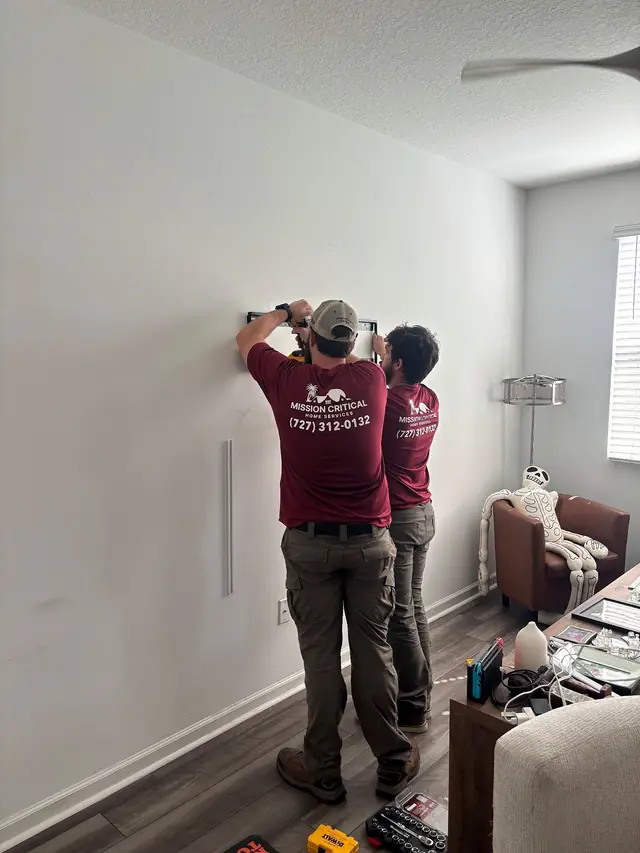
Here's our crew setting a TV wall bracket in a Spring Hill living room. Picture, mirror and TV mounting is everyday handyman work for us, along with the furniture assembly that usually comes with a new room setup.
Got a new TV waiting in the box? Tell us about the wall and we'll come take a look.
What one TV mounting customer said
Great great great great!!! They are the best! Fast, efficient, clean, nice, and reasonable. Thanks for your service!TV mounting