Smoke Alarms: How Often to Test, When to Replace, Where They Go
4 min readMission Critical Home Services
Smoke alarms are the cheapest safety equipment in a house, and the easiest to forget about. Most people know to change the battery when one chirps. Far fewer know that the alarm itself wears out. According to the National Fire Protection Association (NFPA), about three out of five home fire deaths happen in homes with no smoke alarms or with alarms that didn't work.
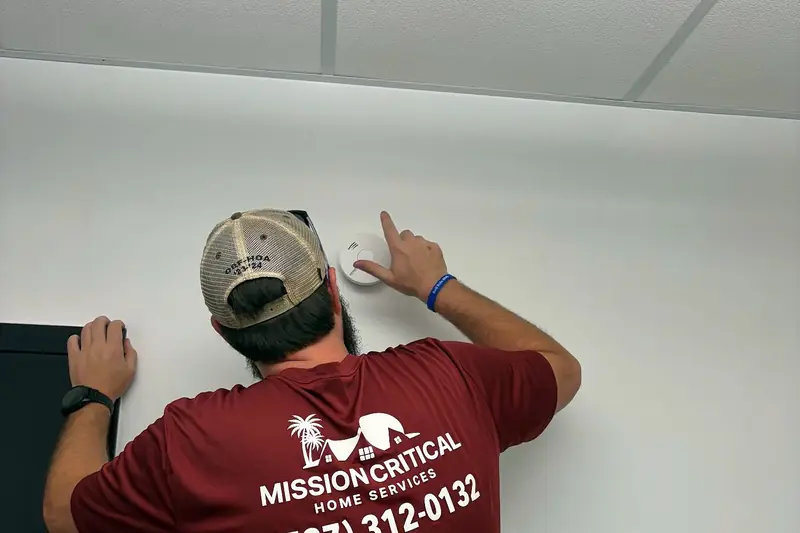
Here's the short version of what to do and when, from a team that puts them up and looks after them. The photo at the top is from a recent smoke alarm installation in Spring Hill.
Test every alarm once a month
Press and hold the test button until the alarm sounds. A loud, steady alarm means the horn and the battery are working. A weak sound, or nothing at all, means a dead battery or a dead alarm.
If you can't reach the ceiling safely, don't climb on a chair to do it. Press the button with a broom handle, or have someone help.
The chirp, and the batteries
A single chirp every 30 to 60 seconds almost always means one of two things: the battery is low, or the alarm has reached the end of its life and wants replacing. The label on the back explains which pattern means what on your model.
- Replaceable batteries: change them at least once a year, even if the alarm isn't chirping.
- Sealed 10-year batteries: there's no battery to change. When the alarm signals end of life, replace the whole unit.
- Hardwired alarms: these run on house power with a backup battery, and the backup battery still needs changing.
Never pull the battery to stop false alarms from cooking. Most alarms have a hush button that quiets them for a few minutes, and moving the alarm farther from the kitchen fixes the problem for good.
Replace every alarm after 10 years
The sensor inside a smoke alarm degrades with age, and the NFPA recommends replacing smoke alarms 10 years after the date they were made. That date is printed on the back. If you can't find a date, assume the alarm is older than that and replace it.
If your house is more than 10 years old and nobody remembers changing the alarms, they're very likely past due.
Where smoke alarms belong
Placement matters as much as working batteries. NFPA guidance calls for an alarm:
- Inside every bedroom
- Outside each sleeping area, such as the hallway outside the bedrooms
- On every level of the home, if you have more than one
A few placement habits that prevent false alarms and missed ones:
- Keep alarms about 10 feet from the stove or cooktop.
- Keep them away from bathroom doors, where shower steam can set them off.
- Avoid spots right beside ceiling fans and AC supply vents, where moving air can push smoke away from the sensor.
- Mount them on the ceiling, or high on the wall, following the instructions in the box.
Connect them so one sets off all
When alarms are interconnected, smoke in one room sets off every alarm in the house. That matters at night, with bedroom doors closed and the AC running. Many newer homes have hardwired interconnected alarms. In older homes, wireless interconnected alarms do the same job without running new wires.
Add carbon monoxide alarms
Carbon monoxide has no smell, and a smoke alarm won't detect it unless it's a combination smoke and CO alarm. You need CO alarms if the house has gas appliances, a fireplace or an attached garage. Put them outside the sleeping areas and on each level.
A note on hardwired alarms
If your alarms are wired into the house, a replacement has to fit the existing connector or come with an adapter for it, and interconnected alarms generally need to be compatible with each other, which usually means the same brand. If the wiring itself needs to change, or a new spot needs power run to it, that's work for a licensed electrician.
For parents and anyone hard of hearing
A standard alarm may not wake someone who is hard of hearing, or who takes medication that makes them sleep deeply. Alarms with strobe lights and bed shakers are made for exactly that. If you're helping a parent stay safely in their home, it's one of the simplest upgrades there is.
We can take this off your list
Smoke and CO detector maintenance is part of our home maintenance work: testing every alarm, changing batteries, checking the dates and putting up new alarms where they're due. If yours are chirping, missing or past their date, let us know.