Water Pooling by Your House? How a Buried Downspout Extension Works
5 min readMission Critical Home Services
A summer thunderstorm in Hernando or Pasco County can drop an inch or more of rain in an hour. Every inch that falls on 1,000 square feet of roof is roughly 620 gallons of water, and your gutters funnel all of it to a handful of downspouts. Where each downspout lets go of that water matters more than most people think.
If a downspout empties right beside the house, the water has nowhere to go but into the soil against your foundation, across your walkway or under the lanai slab. A buried downspout extension carries that water underground to a spot in the yard where it can soak in or drain away.
Signs a downspout is dumping water in the wrong place
Walk around the outside of the house during or right after a good rain. You're looking for:
- Puddles beside the foundation that are still there hours after the storm
- A bare, washed-out hollow in the dirt or mulch under the downspout
- Rock, mulch or soil from the beds washing across the walkway or driveway
- Green or black staining low on the stucco where water keeps splashing back
- Water creeping toward the garage door, a slider or the lanai
- Ground that stays soggy long enough to breed mosquitoes
One of these on its own isn't an emergency. Several together, every time it rains, means the water needs to go somewhere else.
Three ways to move downspout water
Splash blocks are the concrete or plastic trays that sit under a downspout. They're cheap and they stop a hollow from forming, but they only move the water a foot or two from the wall.
Above-ground extensions are flexible or rigid pipe laid on the grass. They move water farther, but they're easy to trip over, they get in the way of the mower and they get knocked loose.
Buried extensions run the same water through pipe under the ground and let it out well away from the house. There's nothing to trip over and nothing to move when you mow, and the water ends up where you choose.
How a buried downspout extension goes in
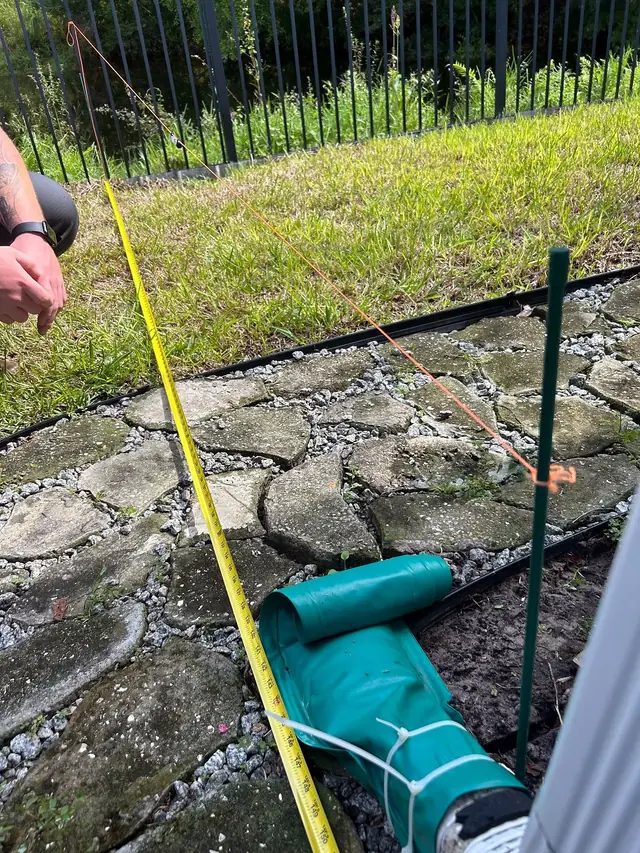
On a recent job in New Port Richey, the downspout at the corner of the house was emptying onto a stone path right beside the foundation. Here's how we handled it:
- Plan the route. We measured from the downspout across the yard and marked the line the pipe would follow, so it would drop steadily the whole way and come out where the yard could take the water.
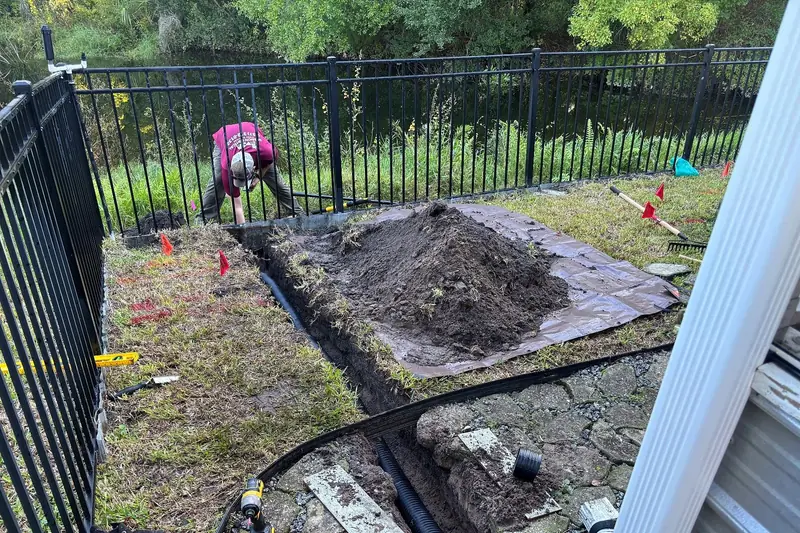
- Dig the trench. We cut the trench along the marked line and kept the soil on a tarp, so the lawn stayed clean and the dirt could go back in.
- Lay the pipe. An adapter connects the bottom of the downspout to drain pipe that runs the length of the trench. The pipe has to slope downhill the entire way, because a low spot lets water and silt sit in the line.
- Backfill and put everything back. We backfilled and packed the trench, then reset the stepping stones so the path looks the way it did before, minus the puddle.
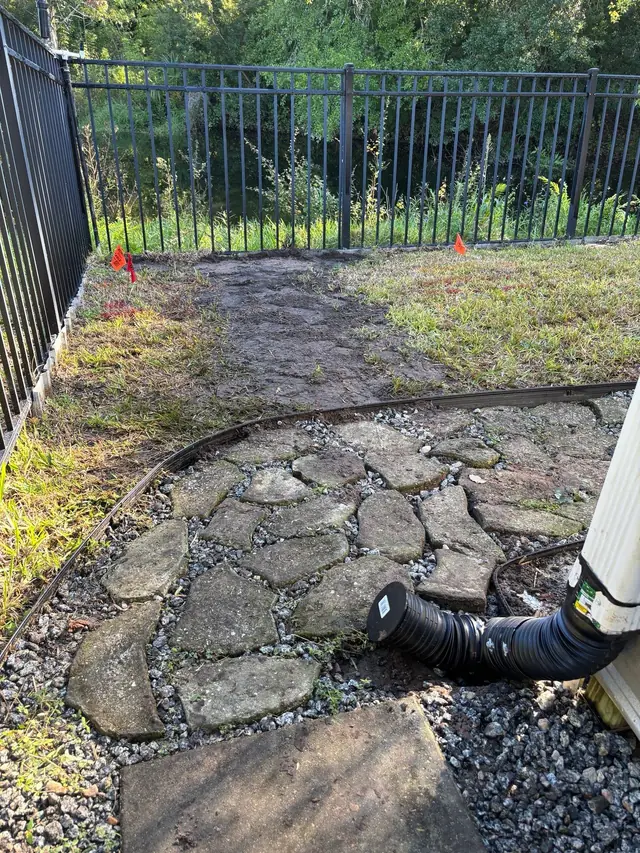
Now the roof water from that corner travels under the path and ends up out in the yard instead of against the house and the walkway.
Where the water should come out
The end of the pipe matters as much as the pipe itself. A few rules we follow:
- Downhill and away. The outlet should sit lower than the downspout and far enough from the house that water can't run back toward it. A few feet is the bare minimum; ten or more is better if the yard allows it.
- Not onto a neighbor's property. Sending your water into someone else's yard is a fast way to start an argument, and many HOAs have rules about it.
- Not over the septic drainfield. Many homes in Hernando and Pasco are on septic, and extra water soaking the drainfield is the last thing it needs.
- Not across a sidewalk or driveway. Constant runoff grows algae, and algae on concrete is slippery.
Many buried extensions finish at a pop-up emitter: a small cap that sits flush with the lawn, lifts open when water pushes through and drops closed again so leaves and critters stay out.
Keeping it working
A buried extension needs very little attention, but not none:
- Keep the gutters clean. Leaves and roof grit that get past the gutter end up in the pipe. Clean gutters mean a clean line.
- Check the outlet after big storms. Make sure it can open and isn't buried under mulch or grass clippings.
- Flush it once in a while. Running a garden hose into the downspout for a few minutes shows you the water comes out the far end.
When it's more than a downspout
A downspout extension deals with roof water. It won't change a yard that slopes toward the house, water coming up through the slab or cracks in the foundation. If the ground itself is graded the wrong way, or you're seeing water inside, that's a job for a drainage or foundation specialist, and we'll tell you so if that's what we find.
Rain pooling by your house? Send us a photo and we'll tell you what it would take. Downspout extensions and gutter and downspout cleaning are part of our home maintenance work.
What one drainage customer said
Requested a quote for a drainage project from a gutter downspout to the edge of the yard to a lake (20ft)…Matt and Cameron (Veterans) came to check the project at hand and were very professional and personable while they listened and asked questions to ensure we were on the same page of the outcome of the project. I had also requested other companies to come out and give a quote and Mission critical came back with not only a reasonable cost however, they also ensured they advise me approximately when they would be able to come out (weather permitting) as well as duration of project overall. They came as scheduled and finished the project within one day with positive outcomes of what was needed. Highly recommend them for this type project and or any other handyman type project, you may need . Have them come out and and they will look over your project type and provide a detailed free written quote.Yard drainage